
The key points in 30 seconds:
→ Changing your attitude and intention isn't enough, in between sits the "intention-behavior gap."
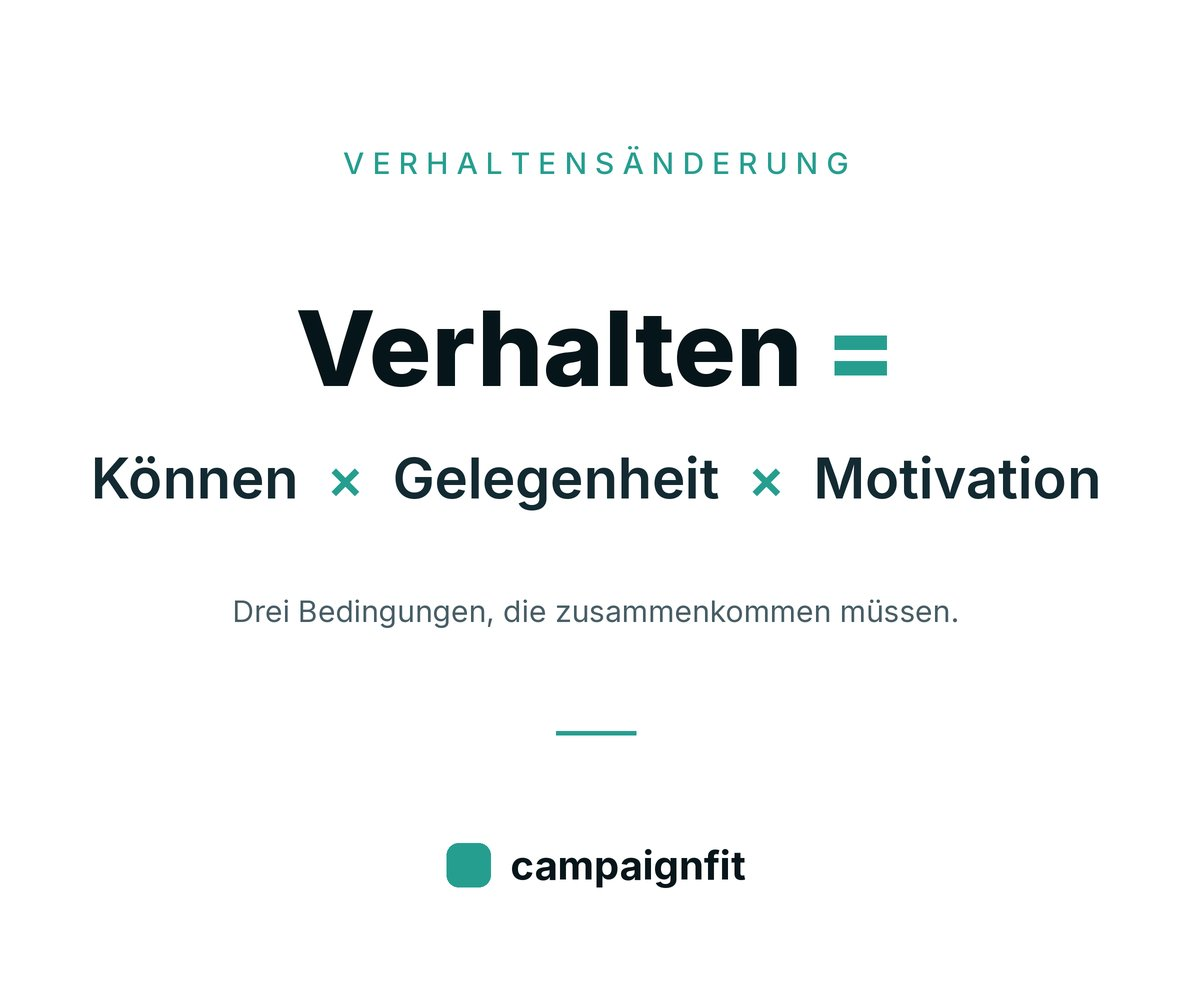
→ Behavior needs three conditions at once: Capability × Opportunity × Motivation (COM-B model).
→ If one of them is missing, the behavior doesn't happen.
→ In practice, almost only motivation gets worked on, capability and opportunity are left aside. That's exactly where change fails.
Why this matters for leadership: KPIs measure the outcome, yesterday's receipt. What moves it is behavior: capability, opportunity, motivation. There, in the conditions, you can steer before the number.
The intention-behavior gap
Changing your own behavior is hard, privately and professionally. You've reflected, realized something, set an intention. And then it holds for a few days. Maybe a few weeks. Then the old pattern is back.
Social psychology calls this the intention-behavior gap. Even when you seriously want to change your attitude and intention, that often doesn't translate into actual behavior (Conner & Norman, 2026). Good intentions alone move little.
Three conditions: the COM-B model
Slightly simplified, but essentially true: according to the COM-B model (Michie et al., 2011), behavior needs three conditions that must come together.
Capability
You have to be able to actually perform and show the new behavior, knowledge, skill, routine. Without capability, the best will is useless.
Opportunity
You need an environment that allows the behavior in the first place: structures, time, occasions. Without opportunity, capability stays unused.
Motivation
Will and attitude. The part that practice almost always targets, and the one that, on its own, carries the least.
What this means for leadership and organizational development
In leadership and organizational development, people often target motivation. Workshops, impulses, appeals. Capability and opportunity rarely get a close look, and people trust that it'll somehow work out.
It usually doesn't. You need the right structures so that people can show the new behavior at all. And you need enough opportunities, to practice, to show it, to repeat. Otherwise the best intention fizzles out in everyday work.
Honestly
How many changes in your company are still visible in daily work after a short time? If the honest answer is "few," it's rarely down to a lack of will. Usually capability or opportunity is missing, and no one looked.
Sources
Conner, M., & Norman, P. (2026). Attitudes, intentions, and behavior change. Annual Review of Psychology, 77, 311-337.
Michie, S., van Stralen, M. M., & West, R. (2011). The behaviour change wheel: A new method for characterising and designing behaviour change interventions. Implementation Science, 6, 42. doi.org/10.1186/1748-5908-6-42
Change that sticks.
I support Swiss organizations in leadership and organizational development, on site, with structure and enough opportunity to practice, until the new behavior holds. A 30-minute conversation, no sales pitch, straight talk.