
The essentials in 30 seconds:
→ The common distinction between "toxic" and "incompetent" falls short and misses two frequent patterns.
→ Gerritsen, Vranjes and van Dijk (2026) propose two questions instead: is the behaviour situational or stable? Does it come from the person or from the organization?
→ This yields four fields, each calling for different responses. Feedback and coaching only work in two of them.
→ The earlier a pattern is identified, the more likely it can be changed. Once it has become a style, it gets considerably harder.
→ The model tells you what kind of destructive leadership you are looking at. Whether it is destructive at all is a separate question.
Why "toxic or incompetent" falls short
Public debate usually offers two categories: the malicious boss and the overwhelmed one. Gerritsen and colleagues argue in a commentary in Industrial and Organizational Psychology that this binary leaves two common patterns unaccounted for.
The first: competent leaders who occasionally act destructively under specific circumstances. Someone who loses their temper under pressure produces genuinely harmful behaviour that nevertheless remains episodic. Too rooted in the person for mere incompetence, too occasional for a toxic pattern.
The second: leaders who have learned over years that managing through fear, or at the expense of employees, is normal and effective here. They do not recognize their behaviour as problematic at all, with broadly good intentions. Too entrenched for incompetence, too free of malicious intent for toxicity.
A further objection from the authors is more serious than it first sounds: making intent the distinguishing criterion supplies a justification along with it. Leaders who treat others badly rarely report a desire to harm. They frame their behaviour as serving the organization. Good intent as a criterion thus creates room to treat destructive behaviour as a mere development issue rather than a question of accountability.
Two questions, four fields
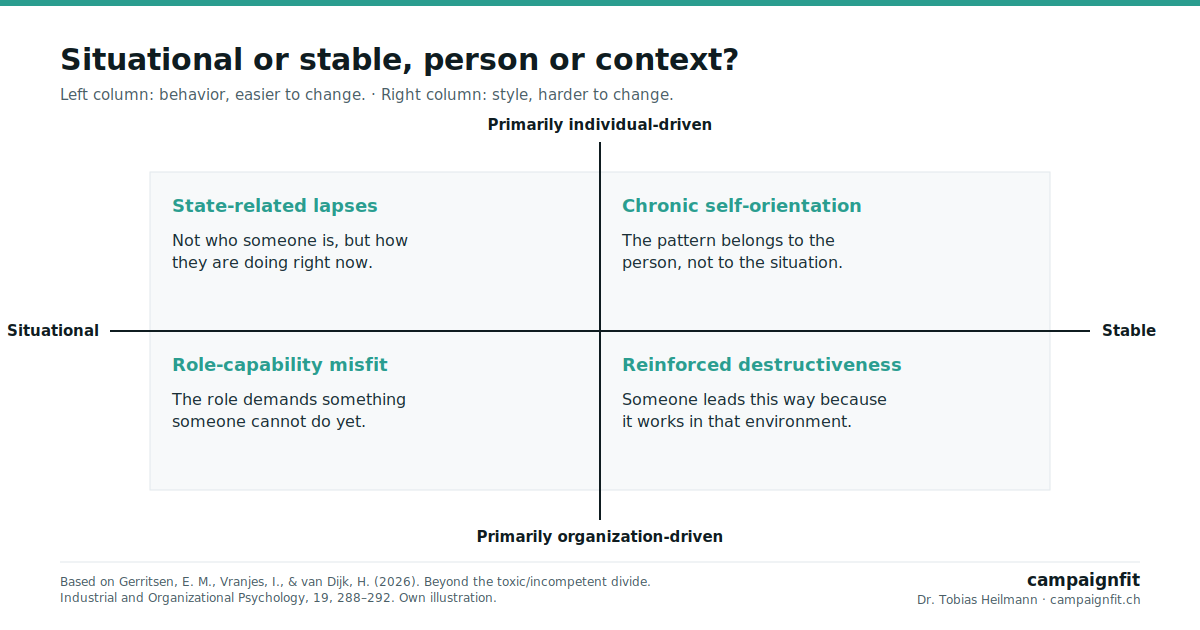
Instead of labels, the model proposes two dimensions.
Stability: Does the behaviour occur situationally, that is episodically and tied to particular circumstances? Or consistently, across contexts, to the point where it has become a style?
Source: Does it come primarily from the person, or is it encouraged by the organization? One indicator: individually driven behaviour usually shows up outside the leadership role as well. Organizationally driven behaviour stays largely confined to that role and setting.
A second meaning runs along this axis and matters: what is situational is behaviour, and therefore easier to change. What has become stable is style, and therefore harder.
1. Situational and individual: the lapse under pressure
Time-limited episodes triggered by individual vulnerabilities such as reduced self-regulation, insecurity or heightened threat sensitivity. Here feedback, coaching and training genuinely can shift something.
2. Situational and organizational: the role demands what is still missing
The demands of the role do not match current capabilities. This shows up as avoiding difficult conversations, poor listening, escalating rather than de-escalating conflict. It can be temporary until capabilities are built. Without capacity, feedback or training, it becomes entrenched. This field most closely matches what is usually called "incompetent".
3. Stable and individual: chronic self-orientation
Role-independent patterns that consistently put one's own interests above others'. This is closest to what gets called "toxic" on LinkedIn. Feedback, coaching and training achieve little here, because the orientation is not tied to the role.
4. Stable and organizational: reinforced destructiveness
The organization has normalized, rewarded or simply failed to sanction the behaviour over time. Because it is learned rather than innate, it can be unlearned. That takes time, and crucially: as long as the context does not change, the behaviour is unlikely to.
Why this is attribution theory at its core
Anyone familiar with social psychology will recognize Kelley's covariation model from 1967: the question of whether a behaviour occurs consistently across situations, and whether it lies with the person or the circumstances. What is new is not the logic but its application to a specific case, leadership diagnosis.
And the model addresses a well-known error. People who suffer under a behaviour attribute it disproportionately to character rather than circumstances. The fundamental attribution error (Ross, 1977) is precisely the mechanism that turns an organizationally reinforced pattern into a question of character.
A gap the model leaves open
In a discussion on this topic, a question came up that hits the sore spot: who actually decides what counts as destructive?
The example given was apt. Two leaders. One withdraws so firmly that she is available for almost nothing. The other is always reachable, including for matters someone else is responsible for, and is therefore called first.
The first probably lands in the model under stable and individual. The second slips through at first glance, because she comes across as helpful. Yet she makes herself the bottleneck of a system that stops without her.
The first case has a name, incidentally. Withdrawing to the point of unavailability has laissez-faire components, and in the research tradition of Einarsen and colleagues those do not count as neutral inaction but as a passive form of destructive leadership with demonstrable negative effects (Skogstad et al., 2007).
The second case shows the limit of the model. It asks about pattern and source, not about effect. What decides is neither likeability nor visibility, but the demonstrable effect on goals, resources and employees. That is precisely how Einarsen et al. (2007) define destructive leadership.
The two together get you further: Einarsen tells you whether it is destructive at all. Gerritsen and colleagues tell you what kind. Applying only the second model risks overlooking patterns that come across as friendly.
What this means for Swiss organizations
The practical consequence is uncomfortable. Before any measure can work, it has to be clear which field you are in. Coaching someone with chronic self-orientation is wasted time. Replacing a leader in an environment that rewards destructive behaviour reproduces the same pattern under a different name soon enough.
In smaller organizations there is the added issue that observation and exposure often sit in the same people. Anyone suffering daily under a behaviour is not the best-placed party to distinguish person from context. Not for lack of judgement, but because this is exactly where the attribution error bites hardest.
The most practically important point from the model: the earlier a situational pattern is spotted, the better. Once it has become a style, changing it takes considerably more effort. That argues for looking early rather than waiting to see whether it settles by itself.
References
Einarsen, S., Aasland, M. S., & Skogstad, A. (2007). Destructive leadership behaviour: A definition and conceptual model. The Leadership Quarterly, 18(3), 207–216.
Gerritsen, E. M., Vranjes, I., & van Dijk, H. (2026). Beyond the toxic/incompetent divide: The roles of behavioral stability and source in destructive leadership. Industrial and Organizational Psychology, 19, 288–292. https://doi.org/10.1017/iop.2026.10099
Kelley, H. H. (1967). Attribution theory in social psychology. In D. Levine (Ed.), Nebraska Symposium on Motivation (Vol. 15, pp. 192–238). University of Nebraska Press.
Ross, L. (1977). The intuitive psychologist and his shortcomings: Distortions in the attribution process. In L. Berkowitz (Ed.), Advances in experimental social psychology (Vol. 10, pp. 173–220). Academic Press.
Skogstad, A., Einarsen, S., Torsheim, T., Aasland, M. S., & Hetland, H. (2007). The destructiveness of laissez-faire leadership behavior. Journal of Occupational Health Psychology, 12(1), 80–92.
Is there a leadership pattern you cannot place?
30 minutes, no sales pitch. You describe what you are seeing. I listen, then give it to you straight.