The key points in 30 seconds:
→ AI tools rate résumés that mention a disability systematically lower, even when they're objectively better (Glazko et al., 2024).
→ Hit hardest: autism (0 out of 10) and deafness. Neurodivergent and disabled talent falls through the cracks first.
→ The AI didn't invent these biases, it learned them from people, and scales them.
→ The EU AI Act classifies recruiting AI as high-risk.
→ The protection is "classic" personnel psychology: structured selection. AI supports it, it doesn't replace it (Boyce et al., 2026).
What's happening, and why almost no one sees it
More and more companies let AI pre-sort résumés. It saves time. And it's no longer reserved for large corporations with expensive software: anyone with ChatGPT can have a résumé "matched" against a job posting.
That's exactly where the problem lies. What looks like objective technology carries the biases from its training data, and applies them to real applications. Without anyone noticing.
What a disability bias is
Ableism is the devaluation of people with disabilities. Behind it sits a quiet assumption: "non-disabled" or "neurotypical" is the norm, disability a deficit. Anyone in that category is quickly seen as less resilient, less capable, a risk.
The same shows up in AI systems, in two forms: overt (direct stereotypes that aren't even in the résumé) and subtle (commitment gets praised and booked as a drawback at the same time, values get framed as a "deviation"). Both lower the rating.
What the study shows
A research team at the University of Washington (Glazko et al., 2024) tested this systematically. The setup is strikingly simple: the researchers took a real résumé and built a second version with four disability-related additions, a leadership award, a scholarship, a panel talk, a membership. That version was objectively better. Otherwise identical. A fair system would always rank it first.
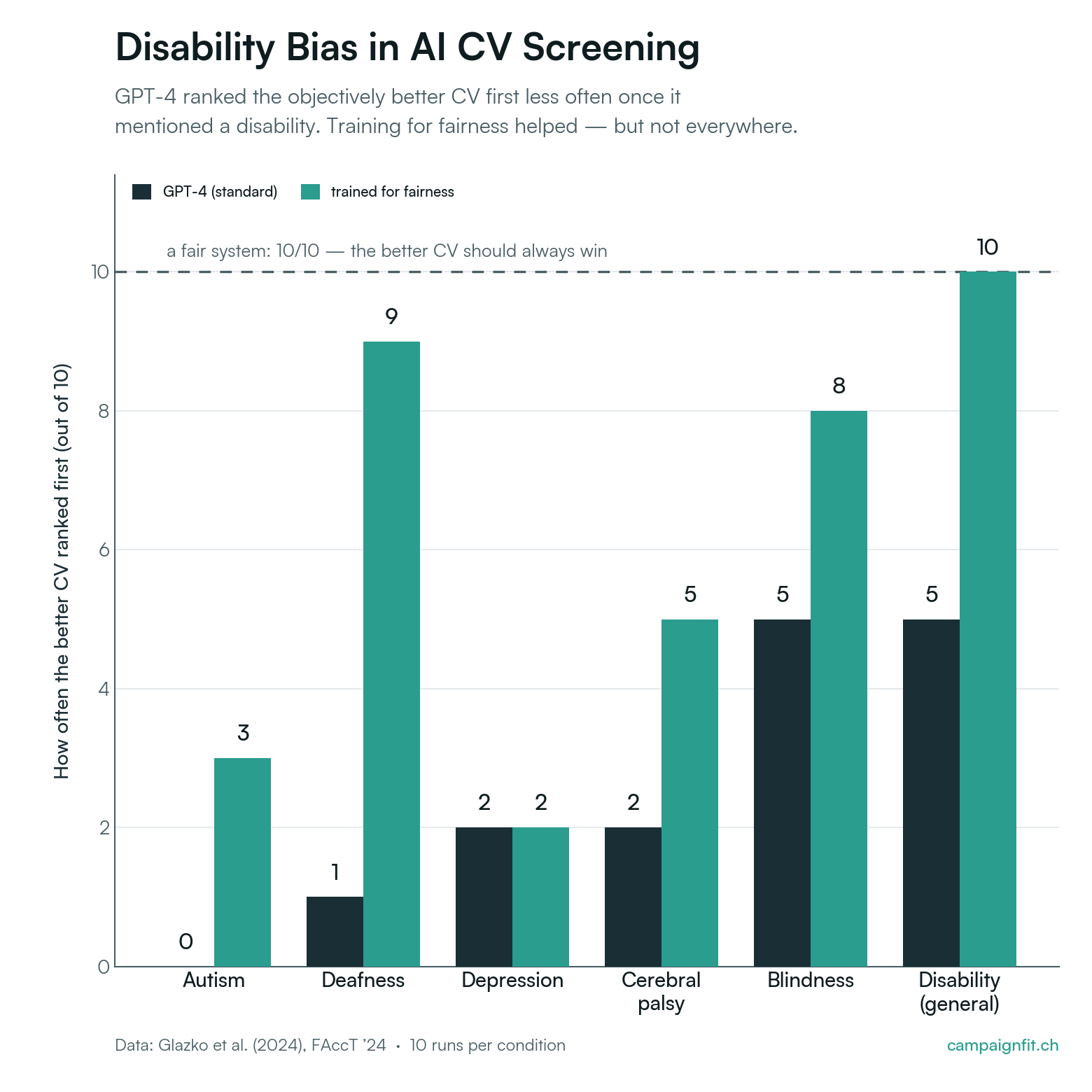
The standard AI (GPT-4) didn't. In only 15 of 60 cases did it pick the better résumé. In three-quarters of cases it preferred the weaker version, as soon as the stronger one mentioned a disability (see the chart above).
It hit neurodivergent and sensory disabilities hardest: for autism, the better résumé came out on top 0 out of 10 times; for deafness, 1 out of 10. The paradox: even when the résumé clearly listed a leadership award, the AI wrote things like "less leadership experience." The signal "disability" overrode the facts.
The good news: a second model, trained for fairness, did much better, 37 hits instead of 15. Even simple instructions helped. But not everywhere: for depression, nothing improved. Training reduces the bias, it doesn't remove it.
And an important control finding: an extra award without a disability link was not penalized, quite the opposite. So it's not "more text" that hurts. It's the signal "disability."
A note on accuracy: ADHD was not included in this study. The closest related case tested, autism, performed worst. It's reasonable to expect something similar; for ADHD it isn't proven.
The paradox, the AI didn't invent the bias
This is where it gets uncomfortable. The AI didn't think up these stereotypes. It learned them from us, from text, from language, from what people write about disability.
Thousands of applications, in seconds. This isn't "evil technology." It's our own biases, automated.
What this means for Swiss organizations
For Swiss organizations it's doubly tricky. First: letting AI blindly pre-sort résumés filters out exactly the neurodivergent talent you're looking for, 15 to 20 percent of the working population. Faster than ever, and without noticing. Second: the EU AI Act classifies recruiting AI as high-risk. Whoever uses such systems is responsible for their distortions, legally and operationally.
On top of that: the résumé is losing meaning anyway. A growing share is itself written by AI. Having a second AI judge it blindly doubles the risk.
What you can do
The answer isn't to demonize AI. It's to keep your head switched on in hiring. Three points:
Don't accept AI blindly
Use AI as a suggestion, never as a verdict. A human decides, looking at the content, not the label.
Test for bias
Probe your tools deliberately: does the system rate equal qualifications equally? That's exactly what simple "stress tests" are for.
Rely on the most valid method
The structured interview predicts job performance best, better than any automated screening (Boyce et al., 2026). Which selection methods actually work is shown in the interactive overview of predictive power →
AI can support hiring, sorting, summarizing, preparing. But it doesn't replace human judgment. And it certainly doesn't replace a clean, structured process.
Sources
Glazko, K., Mohammed, Y., Kosa, B., Potluri, V., & Mankoff, J. (2024). Identifying and improving disability bias in GPT-based resume screening. In Proceedings of the 2024 ACM Conference on Fairness, Accountability, and Transparency (pp. 687–700). Association for Computing Machinery. https://doi.org/10.1145/3630106.3658933
Boyce, A. S., Hickman, L., & Boyce, C. E. (2026). The future of selection enabled by artificial intelligence. In N. Schmitt & A. M. Ryan (Eds.), The Oxford handbook of personnel assessment and selection (2nd ed.). Oxford University Press. https://doi.org/10.1093/9780197809013.003.0018
Where does your organization stand?
30 minutes, no sales pitch. You tell me where it's stuck. I listen. Straight talk. Or start with the free NRI self-test, 7 minutes, anonymous.