The key points in 30 seconds:
→ 15-20% of the working population is neurodivergent (ADHD, autism, dyslexia), standard recruiting filters them out
→ A bad hire costs Swiss organizations CHF 80'000-280'000, the neurodivergent candidate you miss costs more
→ Three adjustments to your recruiting are enough, and they improve the process for everyone
→ ETH Zurich is doing it, your SME can too
What you're losing right now, and why you don't see it
You filled a leadership position. Four months of process, three interview rounds, an offer. Six months later you realize: it's not a fit. What you don't know: the right candidate was there in round one, and slipped through the cracks. Not for lack of competence. Because of a process that couldn't see them.
As a CEO, you lose money and time. As a COO, it costs you team stability and operational quality. As an HR lead, it costs you credibility, and the trust of the business.
A bad hire at leadership level costs between CHF 80'000 and 280'000. That's measurable. What no one measures: the neurodivergent candidate who never got a fair shot. That loss shows up in no number, which is exactly why it keeps happening.
What neurodiversity in recruiting means
Neurodiversity describes the natural variation of human brains. People with ADHD, autism, or dyslexia think differently, not worse. They often show exceptional strengths: pattern recognition, problem-solving, creativity, attention to detail.
The cliché: neurodivergent employees are difficult, unreliable, a risk. The reality: they are what your process makes of them. A process that doesn't see them produces exclusion, not failure.
How standard recruiting excludes neurodivergent talent
Consider the typical recruiting chain of a Swiss organization:
Job posting
Long lists of implicit social requirements ("team player," "communicative," "flexible"). For people with ADHD or autism, these phrases are often unclear, not because they lack the traits, but because they don't know exactly what's meant.
Application documents
Gap-free CVs, error-free cover letters. People with dyslexia or ADHD often produce documents that get filtered out in classic screening processes, before anyone has assessed their content.
Job interview
Unstructured interviews with lots of small talk and implicit social signals. This is exactly where ADHD and autism talent lose points, not for lack of competence, but because their social communication runs differently.
Practical tasks & case studies
Work samples, case studies, mini assessment centers, fair and objective at first glance. But format, time pressure, and unclear expectations systematically disadvantage people with ADHD. Not for lack of ability, but because the task often stays implicit and the situation itself creates stress that masks their performance.
The result is a process that measures social conformity, not performance potential.
What the research says
Structured interviews predict job success twice as well as unstructured conversations, 42% versus 19%. That's the finding of the largest meta-analysis on personnel selection to date: Sackett, Zhang, Berry & Lievens (2023), Journal of Applied Psychology. Yet most companies still rely on unstructured conversations, because they feel "more natural."
The hit rates of all common selection methods compared: Which recruiting methods actually work? →
That costs you accuracy, and it costs neurodivergent candidates their job.
At the same time, studies from the US and UK show that companies actively employing neurodivergent people achieve significant productivity gains in certain areas. SAP, JPMorgan Chase, and Microsoft have documented this systematically. For Swiss organizations this is still new ground, which makes it a competitive edge.
Three adjustments with the biggest effect
You don't have to rebuild your processes from scratch. This isn't an individual fix, no expensive special measures, no long projects. Three concrete adjustments are enough. And they improve the process for everyone, neurodivergent or not.
Introduce structured interviews
Same questions for all candidates, clear scoring criteria, no free-form conversation as the main instrument. This helps all candidates, and gives neurodivergent applicants a fair chance.
Sharpen your requirement profiles
What do you really need for this role? Separate core requirements (what the person must do) from implicit expectations (how they should look doing it). Often "communicative" isn't a criterion for the role, it's an unconscious preference.
Create process clarity
Communicate in advance what candidates can expect: the steps, the timeline, the format. This reduces stress for everyone, and lets neurodivergent candidates prepare at their best.
ADHD at work: not the problem many assume
Many people think of ADHD first in terms of difficulties. That's understandable, but only half the truth.
Research shows: under the right conditions, employees with ADHD perform better than those without, and even outperform them. Traits like willingness to take risks, creativity, and fast thinking in ambiguous situations are typical of people with ADHD. These aren't deficits. They're potential (Olinover et al., 2022, The Leadership Quarterly; Thurik et al., 2016).
The decisive question isn't: "Does this person have ADHD?" It's: "Have we created the right conditions?"
This applies to employees at every level, from clerk to executive. And the adjustments that help people with ADHD usually help everyone.
Why this matters for Swiss organizations
Large companies have HR departments and outside consultants. Swiss organizations don't. The managing director decides who to hire personally. The HR lead carries five other tasks at the same time.
That's exactly why an outside perspective pays off. Not to complicate everything, but to make the simple adjustments that have the biggest effect.
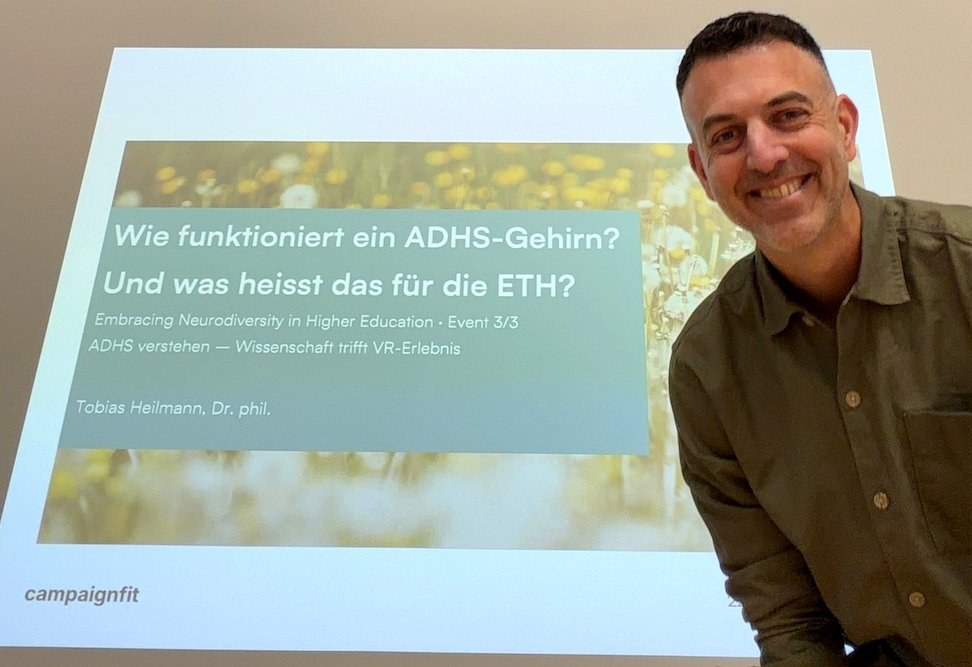
I've worked with Swiss organizations for 15 years. I have ADHD myself. I know which processes work, and which are well-meant but ineffective.
Where does your organization stand?
The free NRI self-test gives you a 10-dimension assessment in 7 minutes. Or talk to me directly, 30 minutes, no sales pitch, straight talk.
Workshop: CHF 190/person, introductory price, currently available. E-mail me.