The key points in 30 seconds:
→ Under the right conditions, employees with ADHD outperform, focus, energy, problem-solving.
→ 15-20% of your employees are neurodivergent. Standard processes aren't built for them.
→ A bad hire costs Swiss organizations CHF 80'000-280'000. A misunderstood top performer costs more.
→ Empathy is measurably trainable, if the tool is authentic (own study: p = .016, r = .89).
→ 2.5h workshop, proven at ETH, introductory price CHF 190/person (was CHF 250), 5-15 people, on site with you in German-speaking Switzerland.
↓ Download this study as a PDF
What it costs to not understand ADHD on your team
A manager who loses her top performer because the way she works is seen as "difficult." A recruiting process that screens out exactly the candidates who would move your company forward. A team conflict that drains energy for months, because no one understands what's actually going on.
Three scenes, one pattern: ADHD goes unrecognized. Behavior is misread. Discipline problems instead of neurocognitive differences. Laziness instead of sensory overload. Disrespect instead of impulsivity.
The damage doesn't show up in a single line, but spread out: in turnover, in sick days, in quiet demotivation, in compliance risks from discrimination claims. Precisely because it's spread out, most companies overlook it, until it hits six figures.
What the research shows
The following findings come from an original longitudinal study I led scientifically in 2025, with 24 interviews with children and adolescents affected by ADHD.
The central question: can empathy for people with ADHD be built through an experiential tool, and is that effect measurable?
The answer: yes. Specifically when those affected help develop the tool. A deliberately revised scene became more authentic after participant feedback, statistically robust (Wilcoxon Signed-Rank Test, p = .016) and with a very large effect size (r = .89 by Cohen). In parallel, the recommendation to teachers rose to 4.82/5, "extremely high."
The study is exploratory-descriptive and makes no claim to representativeness. What it shows is the mechanism: when those affected help shape the tool, you get tools that land in reality. This mechanism doesn't only apply in schools.
What this means for Swiss companies
The study was conducted in an educational context. But the mechanisms apply everywhere neurodivergent people interact with majority structures, in every team, every leadership relationship, every recruiting process.
Recruiting
Standard recruiting screens out neurodivergent talent before its potential ever becomes visible. Structured interviews create fairness and measurably raise the hit rate, from 19% to 42%.
Leadership
Read ADHD behavior as a "discipline problem" and you lead wrong. Understand it, and you can create structures that unlock hyperfocus, creative thinking, and pattern recognition, traits that are disproportionately valuable in volatile markets.
Teamwork
Conflicts in diverse teams arise not from malice, but from a lack of perspective-taking. Empathy is trainable, if the tool is authentic.
Compliance & Inclusion
Discrimination-free processes are no longer optional, they're mandatory. Act substantively here, empirically grounded rather than symbolic, and you gain an edge with candidates, customers, and investors.
What happens in the workshop
2.5 hours · 5-15 people · on site with you in German-speaking Switzerland · proven at ETH. Scientifically grounded, but built for application, not a lecture, but a structured experience.
Module 1: Fundamentals (30 min)
What is ADHD really? Prevalence, neurobiology, strengths, and challenges, based on current research, not clichés.
Module 2: In the Work Context (45 min)
How does ADHD show up at work? Typical situations, misunderstandings, and why "just try harder" doesn't work.
Module 3: Concrete Tools (45 min)
Behavioral-economics interventions for everyday work: meeting structure, feedback timing, workspace design, communication. Every intervention with a checklist.
Module 4: Transfer (30 min)
A personal action plan, quick wins for tomorrow, and how to anchor what you've learned in the team.
What to do differently tomorrow
Three takeaways every participant carries back to the office, not generic coaching knowledge, but ADHD-specific:
1. Ease working memory, in writing, max. 3 points. ADHD isn't "poor listening." It's a working-memory deficit (Barkley, 1997). Verbal briefings with five points vanish on the way back to the desk. Three points in writing stay. That helps everyone, and for employees with ADHD it's the difference between "doesn't deliver" and "delivers exactly."
2. Immediate feedback instead of an annual review. ADHD brains run on dopamine deficits. Delayed feedback simply doesn't work. A brief weekly check-in, even just 5 minutes, gets more out of employees with ADHD than any elaborate performance-management system.
3. Protect hyperfocus, don't interrupt it. If you have an ADHD top performer, protect their deep-work blocks from meeting hops. Hyperfocus is the strength, but every interruption costs twice: once the time, once the re-entry. Two protected half-days a week often deliver more than five scattered ones.
Why work with me
The Swiss market for ADHD consulting is small, but not empty. Three things set my approach apart:
Affected myself, no textbook empathy
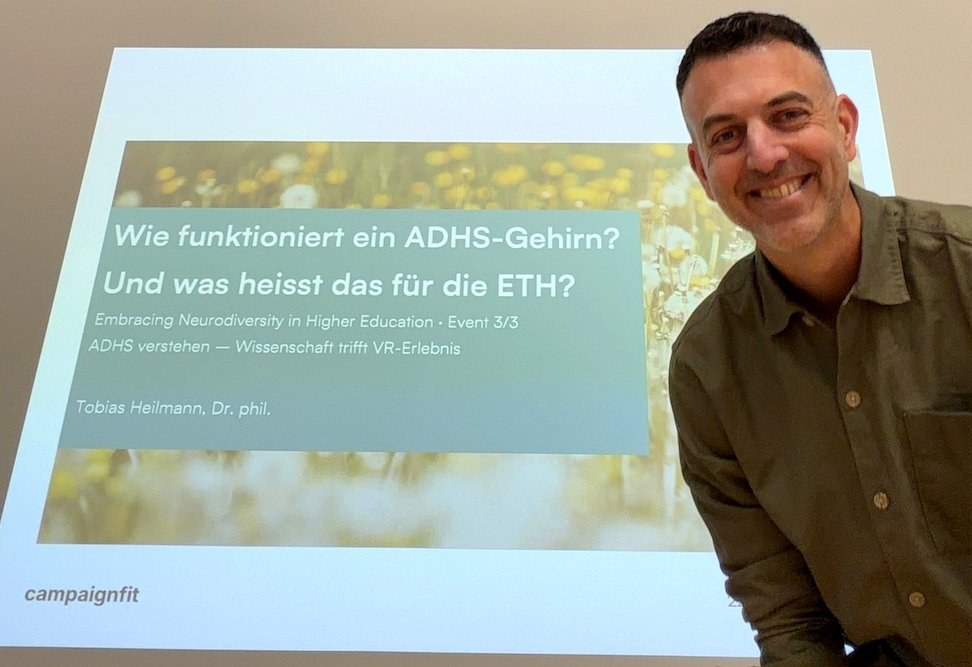
I have ADHD. I don't talk about something I read, I talk about something I live every day. That's the difference between workshops that move people and workshops that only inform.
Scientifically grounded, Dr. phil. UZH, ETH teaching, own study
PhD in business psychology. Teaching at ETH, UZH, ZHAW, HWZ. An original empirical study on ADHD empathy (2025/26). The knowledge I share is verifiable, not read up, but worked out myself.
Swiss organizations, no corporate theory
15 years in practice with Swiss organizations. I know the difference between an 80-person family business and a corporate HR department. What I propose works in your setting, not in a SAP PowerPoint.
Ready for the first step?
A 30-minute conversation, you tell me where it's stuck. I listen. No sales pitch.
Workshop introductory price: CHF 190/person instead of CHF 250 · max. CHF 1'900 flat · currently available.