The key points in 30 seconds:
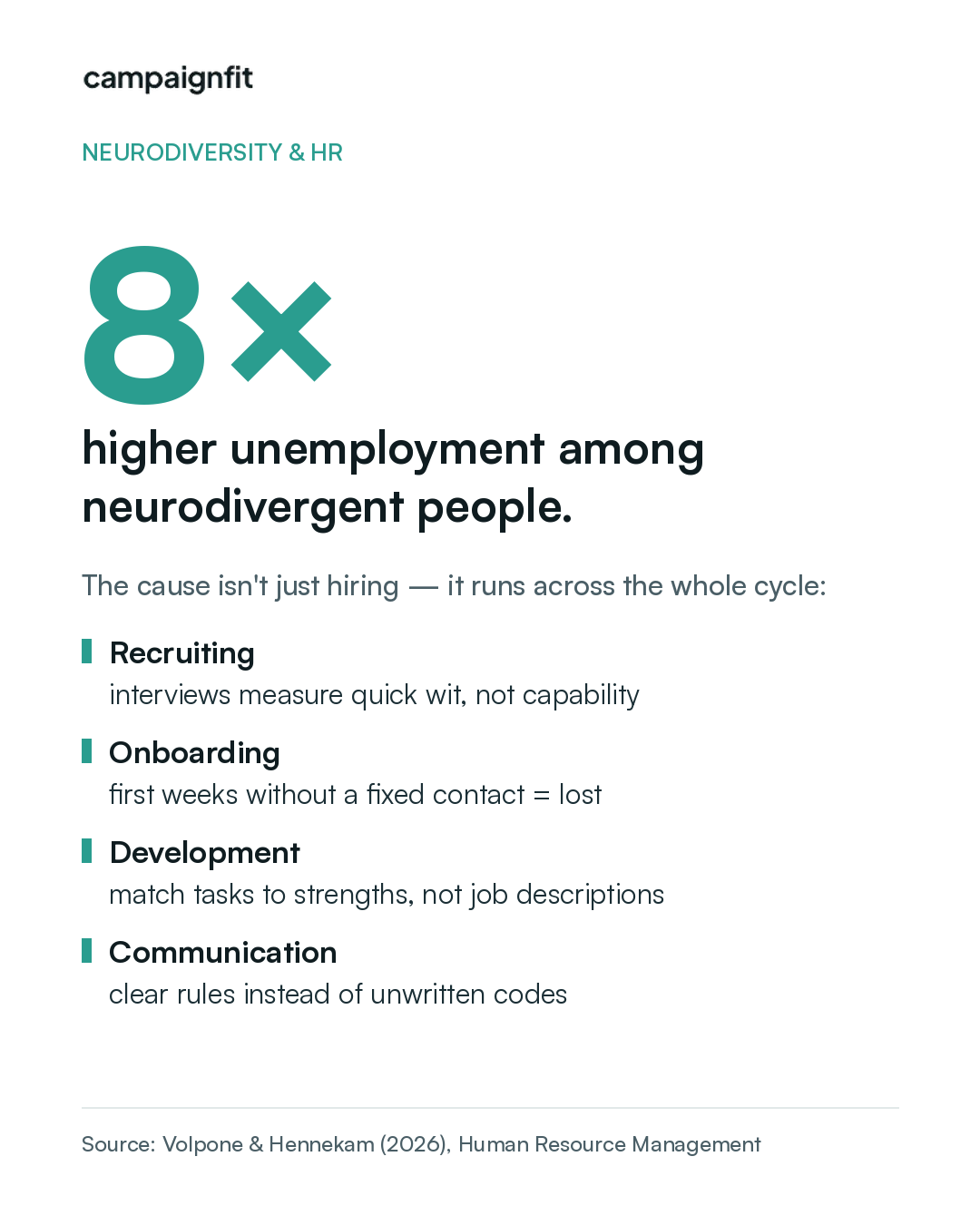
→ Neurodivergent people are roughly 8× more likely to be unemployed than non-disabled people (Volpone & Hennekam, 2026; data: Office for National Statistics, 2021).
→ 15 to 20 percent of the population is neurodivergent, about one in five.
→ A systematic review of 244 studies shows the problem doesn't sit in recruiting alone, it runs across the entire employee lifecycle.
→ The biggest blind spots, in research and in practice: onboarding and compensation.
→ If you want to keep this talent, you adjust the whole cycle, not just hiring.
What the number really says
The figure comes from a recent systematic review in Human Resource Management (Volpone & Hennekam, 2026): neurodivergent people are roughly eight times more likely to be unemployed than non-disabled people, and three times more likely than people with other disabilities (data: Office for National Statistics, 2021).
What matters is what the number does not say. It doesn't say these people deliver less. On the contrary: the research describes a strong willingness and ability to work. What's missing isn't talent, it's the fit between person and process.
Why hiring is only the start
Most "neurodiversity initiatives" focus on a single moment: the hire. Well-intentioned, but too narrow. The review organizes the research across the entire employee lifecycle: from attraction through selection, onboarding and development, all the way to retention. And it shows: talent isn't lost only at hiring. It's lost at every stage that was built for neurotypical norms.
The stages where talent gets lost
Selection
Standard interviews often measure quick wit, social routine and small talk, not actual capability. Those very demands run counter to many neurodivergent ways of working. People who don't shine there are screened out before their ability was ever visible.
Onboarding
One of the biggest gaps sits here: the review found virtually no research on onboarding neurodivergent employees. In practice, a lot is decided in exactly these weeks, the first weeks without a fixed point of contact are often already lost. Job coaches or dedicated buddies change that.
Development
Instead of assigning tasks strictly by job description, a strengths-based fit pays off: align tasks with what someone is genuinely good at. That's not special treatment, it's productivity.
Communication & job design
Much of daily work runs on unwritten codes. When expectations are made explicit, clear rules instead of implicit norms, neurodivergent and neurotypical employees benefit.
The blind spots, in research and practice
What's striking is where the research barely looks. Occupational health and training are studied most. Barely studied is exactly what decides whether people stay: the review found only a handful of studies on retention, very few on performance management, and virtually none on onboarding and compensation.
For Swiss organizations, that's the real message: the expensive losses often happen after hiring, at exactly the stages we know least about.
What you can do
The answer isn't a big diversity campaign. It's three sober steps:
Think across the whole cycle
Don't just ask "How do we hire more inclusively?" but "Where do we lose people after they join?" Onboarding, development and retention belong here.
De-bias your selection
Structured and strengths-based instead of gut feeling. Which selection methods actually predict job success is shown in the interactive overview of predictive validity →
Make retention concrete
A fixed point of contact during onboarding. Tasks matched to strengths (job crafting). Clear rules instead of unwritten ones. Small levers, big effect.
For Swiss organizations, neurodiversity isn't a social cause, it's a business one. The capability is there. The job is to build a process where it can actually become visible.
Sources
Volpone, S. D., & Hennekam, S. (2026). Neurodiversity at work: Challenges and opportunities for human resource management. Human Resource Management, 65(2), 447–471. https://doi.org/10.1002/hrm.70032
Office for National Statistics. (2021). Outcomes for disabled people in the UK: 2020. ons.gov.uk
Where is your team losing potential?
30 minutes, no sales pitch. You tell me where it's stuck. I listen. Straight talk. Or start with the free NRI self-test, 7 minutes, anonymous.