
The essentials in 30 seconds:
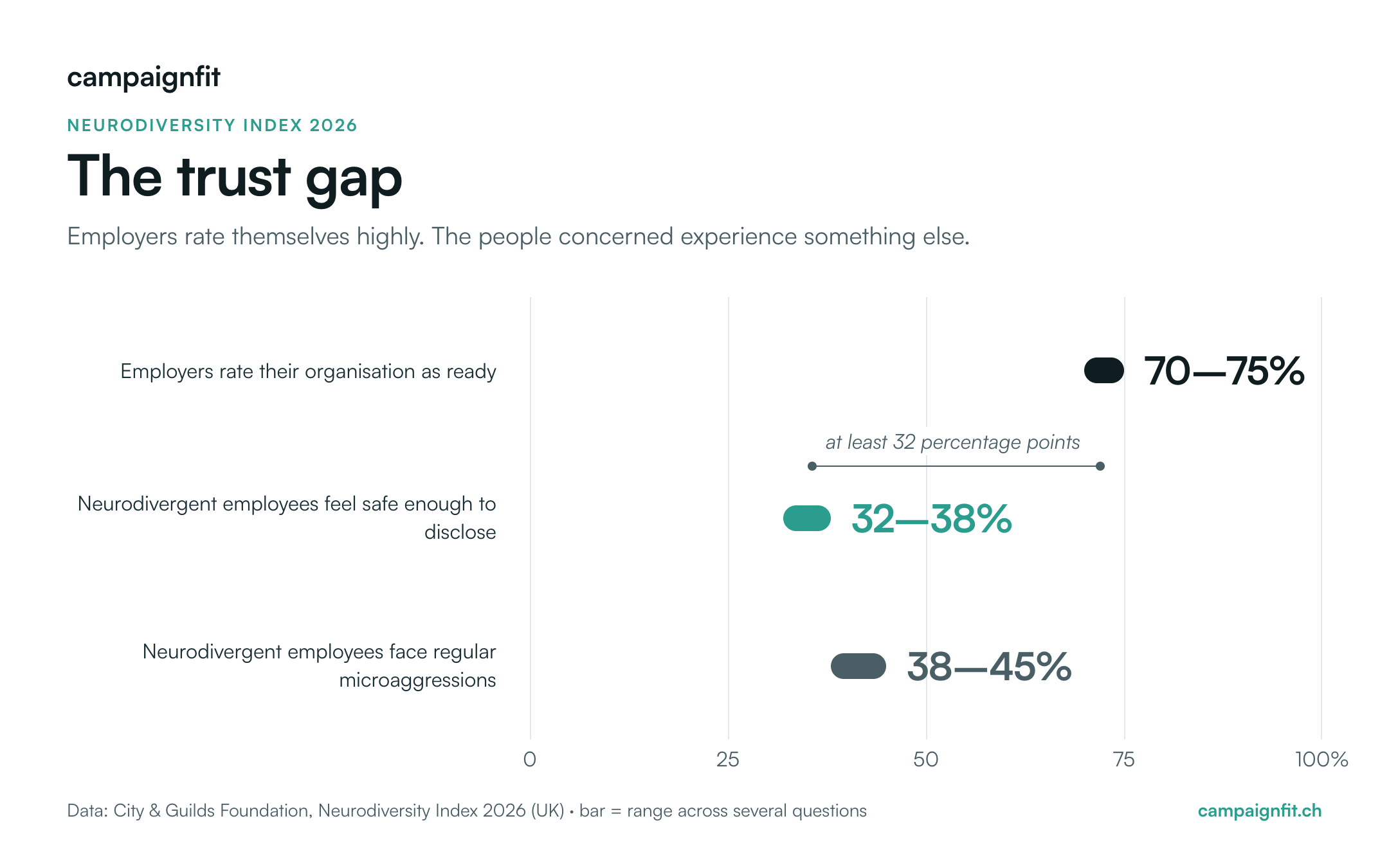
→ 70 to 75 percent of employers rate their organization as ready to support neurodivergent employees (Neurodiversity Index 2026).
→ Only 32 to 38 percent of neurodivergent employees feel safe enough to disclose their diagnosis, or believe their organization understands them.
→ 38 to 45 percent report regular microaggressions at work.
→ The gap is not a question of attitude. It appears wherever good intentions were never translated into processes.
→ Three levers close it: structured selection, contact points outside the reporting line, commitments that can be checked.
Two numbers that do not fit together
The City & Guilds Foundation publishes its Neurodiversity Index for the fourth year in 2026, compiled together with Do-IT Solutions. Two figures in the current edition sit side by side and cannot both hold.
On the employer side: 70 to 75 percent rate their own organization as ready. Policies in place, awareness training done, adjustments possible in principle.
On the employee side: 32 to 38 percent of neurodivergent staff feel safe enough to disclose their diagnosis, or have the impression that their organization understands what is at stake. A distance of at least 32 percentage points between self-image and experience.
One point matters for reading this: the second figure comes from neurodivergent staff, not from the workforce as a whole. The people actually concerned are the ones who were asked.
Why organizations rate themselves too highly
The explanation lies less in willingness than in measurement. Asking an organization about its readiness usually captures what has been decided: a mission statement, a training session, a clause in the staff regulations. Asking employees captures what actually arrives.
There is a well-known gap between intention and behavior. An intention alone does not reliably change action. Capability, opportunity, and motivation have to come together, otherwise implementation fades in everyday work (Michie, van Stralen & West, 2011). A policy creates motivation on paper. It creates neither the manager’s capability in the actual conversation nor the opportunity to raise the subject without risk.
On top of that comes the asymmetry of risk. Anyone who discloses goes first and cannot take it back. Whether that pays off is not decided by the policy, but by whether the surrounding environment visibly shows that such a step carries no consequences. That is precisely what psychological safety describes: the shared belief that interpersonal risk is bearable within the team (Edmondson, 1999). It grows out of experience, not out of announcements.
The finding on microaggressions fits the picture. When 38 to 45 percent regularly experience dismissive remarks or reactions, daily working life keeps supplying evidence against the policy. People believe what they see.
What the gap costs
It stays invisible for a long time because it generates no reports. That is exactly the problem.
No disclosure, no adjustment. Those who say nothing get nothing. Adjustments that cost little or nothing never happen because nobody asks for them. The effort shifts onto the person concerned, who compensates for the environment permanently.
Performance drops before anyone knows the cause. The result looks like a motivation or fit problem. What then gets worked on is the person, not the condition.
Turnover with no visible reason. People leave, and the exit interview names other reasons. The organization learns nothing and repeats the pattern.
In hiring it happens even earlier. Unstructured procedures reward presentation, rapport, and interview routine. Anyone who communicates differently drops out before their abilities have been assessed at all. More on this: Hiring with precision.
Three levers that change the process
1. Structured selection instead of gut feeling
Same questions, same order, rating anchors defined in advance, a task that relates to the actual job. Structured procedures predict job performance considerably better than unstructured conversations (Sackett et al., 2023). They are at the same time the most effective protection against judging by presentation. Structured selection requires no disclosure at all.
2. Contact points outside the reporting line
As long as the only route runs through the direct manager, disclosure is a bet on one individual. A named contact point that sits outside the appraisal chain lowers the risk measurably, because it decouples it. That holds for adjustments as much as for conflicts.
3. Commitments that can be checked
"We are open to adjustments" cannot be checked. "Requests are answered within ten working days, refusals are justified in writing" can be checked. That difference decides whether someone takes the risk. Commitments that can be checked produce exactly the experience trust grows from.
None of the three levers is expensive. All three are craft, not attitude. Why such changes still often fade in everyday work is covered here: Change that lasts.
What this means for Swiss organizations
The index collects UK data. The legal frameworks differ, and the Equality Act 2010 has no direct Swiss equivalent. The figures are therefore not a Swiss measurement, but a pointer to a pattern.
The pattern itself transfers, because it does not depend on the law but on how organizations observe themselves. Self-assessment comes out too favorably wherever it is collected from management rather than from the people concerned.
In Switzerland the employer’s duty of care applies on top of this (Art. 328 of the Code of Obligations). At the same time, a dismissal generally requires no justification. That combination raises the risk of disclosure rather than lowering it.
One structural advantage remains: in SMEs the distances are short. Where management, leadership, and the people concerned sit in the same building, the three levers can be introduced in weeks rather than quarters.
The question actually worth measuring
Anyone who wants to know where their own organization stands does not ask the management whether it feels ready. That question produces the 70 percent.
The robust question is: how many requests for adjustment came in over the past twelve months, and what became of them? If the answer is "none," that is not a sign of readiness. It is the 35 percent figure, simply read from the other direction.
References
City & Guilds Foundation & Do-IT Solutions. (2026). Neurodiversity Index 2026. cityandguildsfoundation.org
Edmondson, A. C. (1999). Psychological safety and learning behavior in work teams. Administrative Science Quarterly, 44(2), 350-383. https://doi.org/10.2307/2666999
Michie, S., van Stralen, M. M., & West, R. (2011). The behaviour change wheel: A new method for characterising and designing behaviour change interventions. Implementation Science, 6, 42. https://doi.org/10.1186/1748-5908-6-42
Sackett, P. R., Zhang, C., Berry, C. M., & Lievens, F. (2023). Revisiting the design of selection systems in light of new findings regarding the validity of widely used predictors. Personnel Psychology, 76(4), 1113-1139. https://doi.org/10.1111/peps.12572
Where does your organization stand?
30 minutes, no sales pitch. You tell me where it's stuck. I listen. Straight talk. Or start with the free NRI self-test, 7 minutes, anonymous.